Saturday, April 14, 2007

There it is, in black and white...

I've just started reading the Mathematica report on abstinence-only education in the US, and goodness, is it ever an interesting document (and I'm only on page 14/164 so far). Hat tip to Vanessa at Feministing for the link.

There has been a considerable amount of speculation in the feminist blogosphere about whether these professional abstinence promoters basically want to promote the idea that poor people shouldn't be having sex. The answer is unequivocally yes, according to this report. From their summary of Title V, Section 510 (b)(2)(A-H) of the Social Security Act (P.L. 104-193), one of the goals of abstinence-only education is to "[t]each the importance of attaining self-sufficiency before engaging in sexual activity." It may depend on how they're defining "self-sufficiency" in this case, but considering the other rhetoric we've seen around welfare recipients, it's pretty obvious that they do, in fact, mean economic self-sufficiency.

In other words, no fucking until you can afford it. If you can never afford it, well, then, you don't deserve sexual pleasure, you lazy piece of worthless trash.

I think I'll be blogging more about this as time goes on, and I think I want to be taking notes as I'm reading, as well.

Suddenly, holding masturbation seminars for low-income people seems very subversive...

Sunday, April 15, 2007

Mathematica Report, Part 3: Sleazy Sources and Self-Sufficiency

In Part 1 of this series, I advanced the radical hypothesis that one of the aims of abstinence-only education is to inculcate the belief, crudely put, "No fucking until you can afford it." In Part 2, I looked at some of the language used in the beginning sections of the report.

While I was taking down my notes, I happened to notice a passing reference that one of the "tenth grade program[s referenced in the study] also featured slide show materials from the Medical Institute for Sexual Health (MISH), which provided information on STDs and instructed students that abstinence is the only sure way to avoid contracting them." (34, as noted previously, all page numbers reflect the pages in the PDF, not the report pagination, for easier reference).

That institute name caught my eye, and got mental alarm bells ringing way in the back of my head. For some reason or other, the juxtaposition of "Medical" and "Institute" (hm, I tried to type "Mental" there; Freudian slip?) makes it seem as though they're desperately pushing for credibility in nomenclature. So who are these crazy MISHed up folks?

Well, according to their own website, MISH "founded to confront the global epidemics of teen pregnancy and sexually transmitted infections (STIs)." Interestingly enough, though, the Google search result page says:
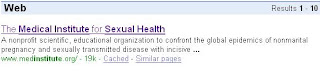


In case you can't read that, it says "A nonprofit scientific, educational organization to confront the global epidemics of nonmarital pregnancy and sexually transmitted disease..." I decided to include a screenshot, because I'm assuming they track statistics and do vanity searches every so often, and I suspect that once they figure out that their Google search result text drops the dime on them, it won't remain as it appears now for very long. (And check out their Executive and Board of Directors while you're there.)

So let's break that down a bit. According to MISH, there is a "global epidemic of nonmarital pregnancy." Do you smell something a bit patriarchal there? I do, I see a couple of male doctors trying to dictate that if women have children, they should do so only within legal marriage...

A little further poking turns up even more evidence of the same:
The healthiest sexual activity is intentional, mutually agreeable, and mutually pleasurable in the context of a respectful, lifelong, mutually monogamous relationship. The healthiest sexual activity occurs between adults who are mature physically, intellectually, emotionally, socially, and spiritually. They are financially self-sufficient and...
And hold on a minute. We just hit paydirt. Financially self-sufficient.

They claim to be interested in promoting optimal sexual health, but their definition of optimally sexually healthy does not include anyone on an economically unsound footing, among other things.

It continues:
...prepared to handle the results of sexual activity. ... For adolescents: delay of sexual debut, ideally until committing to a life-long mutually monogamous relationship such as marriage

For adults: abstinence outside of a life-long mutually monogamous relationship such as marriage


(Personally, for myself, I don't quite understand how you're supposed to have a pleasurable and mutually-satisfactory sexual relationship if you're also expected to have only one sexual partner in your lifetime and commit to that partner before beginning sexual experimentation. To use the same analogy as some other bloggers, that's a little bit like getting your driver's license without ever having been behind the wheel of a car, and then having your first real driving experience be on a ten-lane superhighway.)

According to SIECUS, MISH's study on abstinence-only education
cites mostly unpublished, non-peer reviewed studies to argue that abstinence-only education has a positive impact on teens’ sexual behavior. This contradicts overwhelming evidence from peer-reviewed evaluations of sexuality education programs that show that age-appropriate comprehensive sexuality education programs that include information about contraception as well as promote abstinence are the most effective form of sexuality education for young people.


A report by the Guttmacher Institute says that the President of MISH wrote a
monograph on condoms and STDs, billed as "the most comprehensive scientific review of the science on condom effectiveness to date," MISH provides an analysis of the workshop report that, while factually correct, nonetheless asserts that condoms do not make sex "safe enough" to warrant their promotion for STD prevention [shouldn't that be up to the interested sexually-active parties to decide? -- ?!]. According to MISH, because condoms are "not foolproof" and marriage is "generally safe" from STD infection [except for all those people who get STDs from their spouses, but we won't mention them -- ?!], the government should be only promoting marriage and abstinence outside of marriage for STD prevention.
In other words, these are the same people who persistently keep their heads in the sand about the realities of human sexual behaviour, and insist that other people should submit to their control based on their unenforceable and impractical codes of conduct. They're also the same people who are looking to remove the "C" from the "ABC" HIV-prevention model, thereby condemning untold numbers of people to death.

Have I mentioned yet that this stuff falls neatly within the literal definition of evil?

Not only that, but let's look at some of the people this model excludes:

  • gays and lesbians, who cannot legally marry in many jurisdictions, unless they marry someone of the opposite sex;

  • many disabled people, who cannot find or retain work, and are therefore not "financially self-sufficient";

  • poor people in general;

and anybody else who can't, for one reason or another, get legally married within the jurisdictions they consider their purview.

I suspect too that part of the heavy emphasis on the "no fucking until you can afford it" message is because of the subtle (or not so subtle) anticontraception mentality of the writers and promoters of abstinence-only curricula. What they mean by "wait until you are financially self-sufficient before having sex" is "wait until you are financially self-sufficient before having children," which is not at all the same thing.* However, they would like you to believe, and to act, as though it is.

__________
* Incidentally, there is some evidence that in some cases, early childbirth has little impact on later educational and financial attainment, although I'm having trouble locating the source at the moment. I'm not at all against the idea that one should have enough money to raise kids before having them, but it isn't up to me to enforce that idea on everyone, nor to attempt to deny people the opportunity to have children if they wish based on the contents of their literal or metaphorical bank accounts...

Mathematica Report Part 2: Preliminary Notes

I'm slowly slogging my way through this abstinence-only education report linked in the last post. It's interesting reading, and not only because of the excerpt from the Title V legislation language I quoted.

Here are my initial impressions, with the original quotations in numbered form, and then an exegesis (NB: all page numbers are given as the pages in the PDF, not the actual report pagination):

  1. high-risk girls only

  2. This term has not yet been adequately defined. What constitutes a "high-risk girl" for the purposes of this study? Girls who are at high risk of becoming sexually active outside the "accepted standard" of mutually monogamous sexual activity inside marriage (see the definition of abstinence-only education given in the Title V regs)? Girls who are at high risk of contracting sexually-transmitted diseases? Girls who are at high risk of becoming young or unmarried mothers? While those groups may overlap somewhat (this is basic Venn diagram stuff, keep up with me), there are large areas where the three groups are mutually exclusive.

    I certainly qualify as someone who was at high risk of engaging in sexual activity outside the bounds of either monogamous or marital relationships (as I'm unmarried and polyamorous and knew that I was likely to remain so for a long time even before I started having sex), but I waited until I was 18 -- a legal adult in my jurisdiction -- to begin having sex, have never contracted an STI, aside from swapping a pesky candida* infection back and forth with one long-term, monogamous partner, and I have also never been pregnant, thank goodness.

    I'm not even going to go into how replete with assumed heterosexism this entire report is. In most jurisdictions, teaching that the "accepted standard" is sex only within marriage means that gay people must either remain chaste or marry opposite-sex partners. The heavy emphasis on accidental pregnancy seems to exclude the possibility of lesbian activity as well.


  3. programs did not simply raise the likelihood that youth believed any disease was transmitted sexually; rather, they had a beneficial long-term impact on STD identification (pg 19)

  4. This is actually a positive thing. Knowing what STDs are out there and so on, is generally a good idea. Nothing much to say here, except that I imagine a good programme of comprehensive sex ed that takes into account the reality of premarital sex, would probably accomplish much the same thing. Remind me to come back and harsh on the "accepted standards" thing a bit; it reminds me just a little too much of those behaviour-training films from the 1950s for comfort, and I would also argue that those terms reflect ideational standards (for some people) rather than "expected" standards. (Whose expectations?)


  5. In addition, a sizeable fraction in both [the program and control] groups, about one-in-seven, reported being unsure about condoms' effectiveness for preventing HIV. (20)

  6. This represents a serious failure of education. Note that in the study, the "control" group is not necessarily receiving comprehensive sex ed. I have to wonder if this statistic represents the triumph of the right-wing anticontraception meme that condoms do not, in fact, reduce or prevent HIV transmission. I am not going to go into details here; perhaps someone with more biology background could do it for me?


  7. Program group youth were less likely than control group youth to report that condoms are usually effective at preventing STDs; and they were more likely to report that condoms are never effective at preventing STDs. For example, 21 percent of program group youth reported that condoms never prevent HIV, compared to 17 percent of control group youth. For herpes and HPV, 23 percent of program group youth reported that condoms are never effective, compared to 15 percent of control group youth. (20)

  8. In other words, the Waxman report that showed misinformation, scientific inaccuracies, and outright lies in some abstinence-only education curricula holds true for the curricula reported on here as well. The net effect of inculcating these beliefs, in short, that condoms don't prevent STDs (and that HIV statistic is particularly pernicious, will someone please write about the biomechanics of how condoms prevent HIV transmission?!), will likely be to reduce condom use in the target youth population, at least the ~50% of it that hasn't, as of the release of the report, yet had sex. I can almost follow the thought process entirely: It doesn't matter what I do, I can't prevent getting an STD, so why should I care about trying?


  9. One-quarter of sexually active adolescents nationwide have an STD, and many STDs are lifelong viral infections with no cure. (23)

  10. I do not know where they're getting this statistic, since it isn't sourced, nor what they're classing as an STD, either. It seems like an incredibly high number to me, but I'm not inclined at the moment to go chasing it down. (Note: This is not an argument from incredulity; this is merely noting that I'm skeptical of the authors' intentions in stating an improbable-looking, unsourced statistic, given the provenance of the study and the subject matter, especially given the recent tendencies on the part of policy-makers to insist that the facts are irrelevant in policy decisions.)


  11. STDs have been linked to infertility, miscarriages, cervical cancer, increased HIV risk, and numerous other health problems. Their cost is estimated at several billion dollars annually. (26)

  12. This is an interesting juxtaposition, and an interesting ordering of list items. We can generally assume from basic rhetorical principles of saliency and importance, that an author making a list will front- and end-load the list with the most important items, for greatest rhetorical impact. So what does that say about the writer of the study, that the list items closest to the head of the list are "infertility" and "miscarriages" and the item at the end of the list is "numerous other health problems," where the two items I would consider to be most severe in impact -- cervical cancer, and HIV risk, both of which can and do kill you (and are proven consequenses of STD infection, rather than merely "linked to" it)**, are buried in the middle?

    I also find it interesting that the very next sentence discusses the "cost" of these various risks, since "cost" is not generally a primary concern (although it is legitimately an important secondary concern) when discussing health policy issues. Also, "cost" is not adequately defined here, either. Is this "cost" in terms of the monetary value of healthcare services provided to treat/ameliorate these conditions? "Cost" as in lost productivity, lost wages, lost potential earnings, what? (Are you noticing a lot of painfully vague terminology in this report? I know I sure am.)

  13. A fifth program— Heritage Keepers in South Carolina (31)

  14. Now that is an interesting choice of nomenclature, particularly juxtaposed with the location, and the methodological notes that the study population was skewed in favour of low-income girls of colour (33). Why does it put me immediately in mind of the Heritage Front meets the Promise Keepers?


I think I'm going to stop there for now, as it occurs to me that the next item in my list of quotations discusses a curriculum called "Vessels of Honor" [sic], and there's probably an entire blog post just in that eight lines or so alone.


_________
* A yeast/jock itch infection, which, if you're in a sexual relationship with someone and one of you gets it, you both should treat yourselves.

** After all, we know a lot of people like to "link" breast cancer to abortion, and Plan B to abortion, when there's no actual connection between either of those pairs of things.